
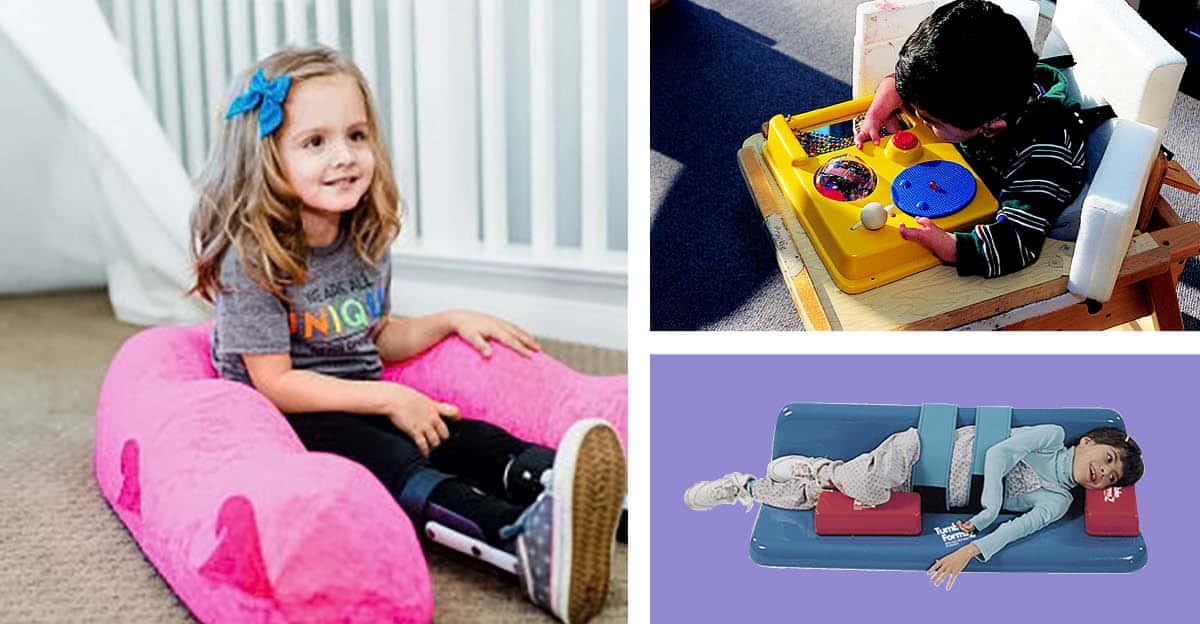
Children with more severe/profound intellectual disabilities and/or those with orthopedic impairments should have a classroom alternate positioning plan in place. Supportive wedges, rolls, and other therapeutic equipment are essential to implementing a successful plan.
Classroom Tools & Solutions for Alternate Positioning
Usually spearheaded by the Physical or Occupational Therapist and supported by the education team, each protocol is designed to meet a student’s unique needs. Let’s look at a few basics that may be helpful for these students:
Transferring out of Wheelchairs
Transferring children out of wheelchairs into alternate options can help reduce the risk of pressure sores from prolonged sitting. Circle time, floor time, study time, and center time are good daily schedule options to implement alternate positioning.
Sidelyers are a useful tool, as chest straps and block accessories can help maintain a comfortable, ergonomic position. For early childhood and/or those not yet using a wheelchair, the Pod from Inspired by Drive is an inclusive seating device that provides comfort and contoured head and trunk support.
Plan for Each Student’s Specific Needs
Allow versatility! The Nessie from Inspired by Drive has options for the child to be positioned in prone (on tummy), in side lying, and with its u-shape, it can wrap around the child’s body to provide supported sitting. Having an assortment of wedges and rolls on hand allows for flexibility in positioning based on the activity and the child’s needs.
Get creative with wedges and rolls for younger children and/or those with developmental delay. A strategically placed wedge can help support critical tummy time, while a half roll can provide stable support for side-sitting.
Adding Engagement to Alternative Positioning Time
Be sure to add activities during alternate positioning time. Use a Sensory Activity Center to work on cause/effect, or place a small Fiber Optic Light within line of sight to encourage visual tracking. A Sensory Mirror is an engaging backdrop for working on eye contact, visual tracking, and expressive and receptive language skills.
Involving appropriate related service providers, including PT, OT, and Speech, will ensure a best-practice, team approach to alternate positioning time in the classroom. Always use adult supervision to monitor for adjustments and safety.
More OT & PT Tips for Students with Special Needs
If you’re looking for more great ideas, tips, and solutions for students with special needs, be sure to visit the Special Needs topic page to see what’s new. To find the complete range of solutions and tools to help students experience school in a more inclusive and positive way, head to the online store.
Shop All: Positioning & Mobility Solutions

Cecilia Cruse, MS, OTR/L has a BS degree in Occupational Therapy from the University of Florida, and her Master’s degree in Education from Georgia State University. She is SIPT certified and has over 25 years of experience in pediatrics with school-based services, acute care, and outpatient pediatric settings.



Leave a Reply