
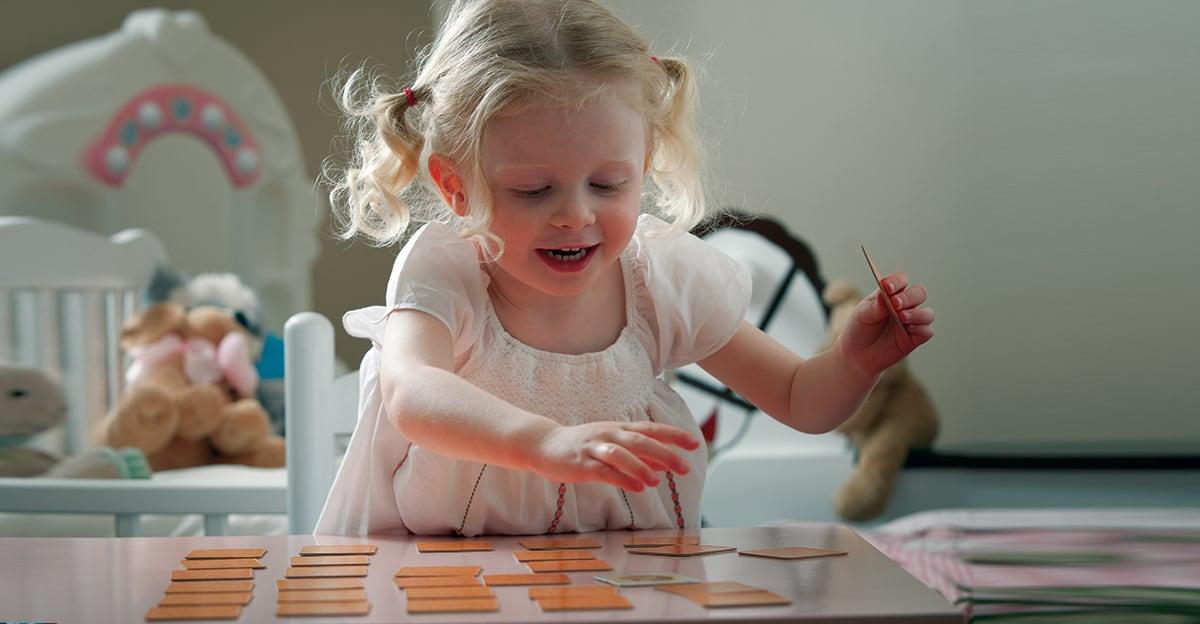
After many years of work in Early Childhood education, I have quite a collection of games that I rely on to make learning engaging and hands-on. One such game is Memory or Concentration. If you aren’t familiar with it or know it by another name, this game involves several cards turned face down, arranged in vertical and horizontal rows that form a grid. Students choose two cards, turn them over, and, if they match (depending on the game’s criteria), keep the pair. Some versions allow children to continue their turn if they get a pair and to keep going until they do not get a pair.
I usually play by the rule of one turn per person, regardless of whether someone gets a pair. This keeps younger children from having to wait too long for a turn, losing interest, and getting frustrated. The winner of the game is the person who collected the most pairs by the end.
The original rendition of Memory, sold in stores and on the School Specialty website, involves matching identical pictures. This ability to match is an important precursor to understanding number sense. One needs to be able to identify like items in order to sort or classify, create patterns, etc. All these concepts set the stage for beginning to understand the order of numbers, quantity, and so on.
Additionally, when the cards need to be counted to determine the winner, children are using number-sense abilities. If the student is a little older, they may be learning to count by twos, which they can practice by counting pairs rather than individual cards.
Another benefit of Memory is the fact that a child must remember where they saw a pair. This involves holding information in working memory, an executive function skill. Executive function is another topic in its own right, but it’s often likened to the air traffic control tower in our brain.
Harvard University’s Center for the Developing Child defines it as, “…the mental processes that enable us to plan, focus attention, remember instructions, and juggle multiple tasks successfully…the brain needs this skill set to filter distractions, prioritize tasks, set and achieve goals, and control impulses.” Memory is excellent for planning, focusing attention, and remembering where an image was last seen, all those mental processes we want enhanced.
In addition to picture-matching Memory, there are many variations that can serve as engaging learning tools for children. Matching upper and lowercase letters, finding the abbreviation to go with the written-out version of a word, and locating contractions that correspond with the individual words the contraction replaces, the list of possibilities is endless.
As a former bilingual and dual language educator, I often work with children learning a second language. Finding the picture and its matching Spanish word, or pairing English words or phrases with their Spanish equivalents, have been fun and effective ways to practice new vocabulary in another language.
One final trick to stretch the educational value of Memory is to have the student help you make the game. Simply use index cards or cardstock squares to make your game pieces. Use cards of the same color so there are no clues to matches, and make sure you can’t see through the cards so little ones aren’t tempted to cheat!
Once you have the cards ready, print pictures, cut them out, and glue them to the cards with your young learner, or have them write or draw on the cards (shapes, numbers, letters, etc.). If you are trying to get them to learn something, such as sight words, for example, what better way to practice that skill than to do so in a meaningful context?
As they write the sight words on the game cards, they may not even realize they are practicing the words, as it is naturally part of the process of creating the game. This is so much more enticing than copying sight words five times each!
Lastly, I would like to share a few game tips to keep in mind. First, while playing the game, have players flip the cards in place and return them to their original spot. This helps keep the game organized, minimize confusion, and maximize the ability to remember where cards are located.
Second, this is the perfect game for two or more players, so it’s flexible depending on who is available to play. Third, for younger children, keep the number of pairs used between eight and twelve so there aren’t too many cards to keep track of, and the game doesn’t last forever.
Even with the store-bought version, select only 16-24 cards from the box, even if it includes more. As children get older, you can increase the number of cards accordingly.
In conclusion, Memory is the perfect go-to game for learning and enjoyment. Besides being easy to make or purchase, this activity is simple to tailor to the skills your student is practicing. Finally, many other skills are embedded within a round of Memory. From executive function skills to social skills like turn-taking, the learning opportunities abound. I assure you, this game will soon become a staple in the learning routine.

Jennifer Fernandez
Jennifer has over 30 years of experience in education. She has degrees in Elementary Education, Spanish, and Bilingual Education and holds teaching licenses in Texas and Minnesota. She has taught PreK-2nd grade in general and bilingual settings, served as a professional learning specialist for seven years, and currently presents at state and national conferences.
Read more by Jennifer Fernandez–>


Leave a Reply