
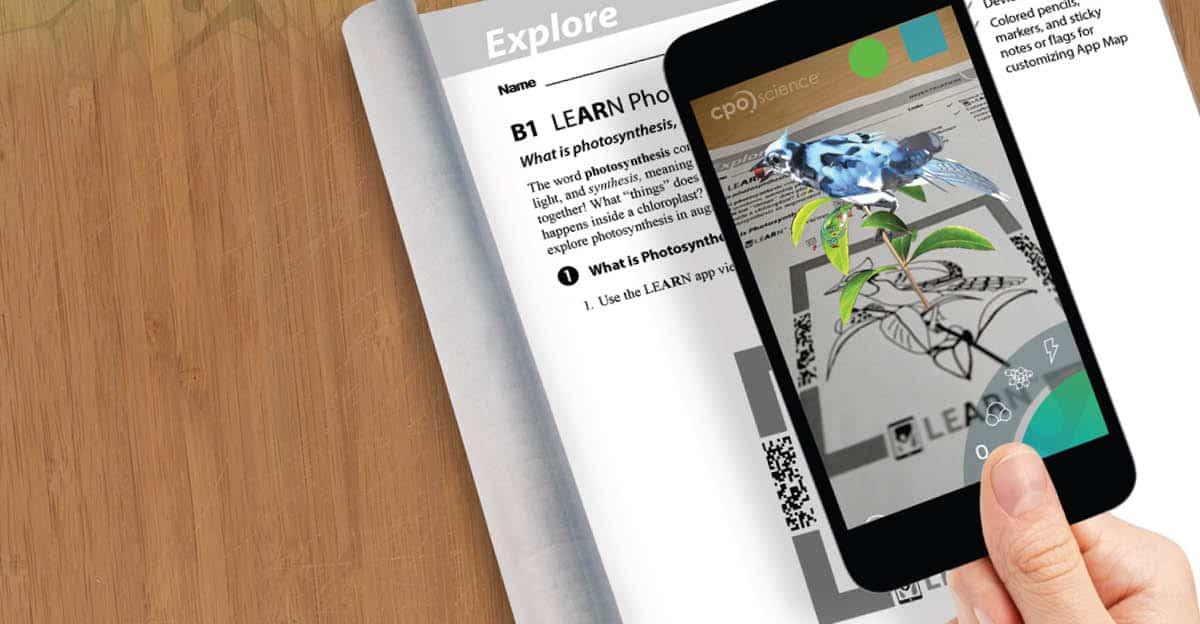
Augmented reality made its true debut in the world of video gaming with exciting options like Pokémon Go, which caught the attention of millions worldwide. This introduction to the potential of augmented reality (AR) opens the door to a range of applications. At its heart, AR offers users a new and more interactive way to engage with content, and with a little creativity, this concept translates easily to the classroom.
What is Augmented Reality?
Augmented reality does what its name implies; it adds content into the real world. Images or markers (called triggers) in the real world are made scannable so they can be read by a mobile device. The triggers give the viewer, via the device’s rear-facing camera, the option to engage with or view additional digital information. In some cases, this involves an image triggering a video, but may also present a 3D image or play an audio track.
How Can Augmented Reality Work in Schools?
Students are arriving in schools with smartphones and tablets in hand, and significantly more technological knowledge than previous generations. Many schools have adopted the 1:1 classroom concept, where each student is provided with their own laptop, netbook, or tablet to use in and out of school. Working alongside the transition to a technology-focused educational experience are augmented reality programs and apps that provide students with access to more in-depth information through mobile devices.
Innovative, pre-made educational resources include integrated triggers and markers for use with mobile devices. The good news is that educators do not need to be completely technologically savvy to provide their students the opportunity to interact with AR in the classroom; educators can simply guide students through the installation of the AR app, and then watch as students are given the opportunity to gain a deeper understanding and further exploration of important concepts.
Hands-on exploration is also possible with AR, as students can manipulate and interact with images captured by the device’s camera. It might not be the classic plastic or paper model hands-on experience, but it offers similar benefits of visual memory and improved concept absorption. Today’s high-tech environment still requires students to think critically, but offers the benefit of developing computer literacy skills and access to the latest tools and apps, both in the classroom and at home.
Augmented Reality Tools for the Science Classroom
Energy Quest, a new title from CPO Science Link, is an innovative and helpful addition to the life science curriculum. Using AR and gameplay, students can interact with the concepts of cellular respiration and photosynthesis, which are typically tough for students to grasp. The Energy Quest curriculum incorporates varying levels of difficulty and detail in each game and AR activity, allowing teachers to customize the educational experience to match students’ needs and understanding. The AR element also allows students to interact with a three-dimensional cell, offering a new perspective and a more comprehensive and interactive visual experience.
To learn more about Energy Quest and its ability to enhance life science curriculum, follow the link below.
ScienceFLEX, a modular supplementary science solution for grades 3-5, uses augmented reality to give students a unique look at the world around them. Take a trip through the inside of the workings of a simple machine or peel back the layers of the Earth to see what lies beneath.




[…] School Specialty. (2017). Benefits of using AR in the Classroom. School Yard. Retrieved from https://blog.schoolspecialty.com/benefits-of-using-ar-in-the-classroom/ […]