
The beginning of the school year offers a unique opportunity for educators to teach students about upcoming US elections. If kids are watching TV at home with their parents, they are likely well aware of the various elections coming up. And, of course, every four years is the US Presidential Election, which adds another layer to teach about how we elect Presidents and other levels of representation.
Even in off years, don’t miss the opportunity to teach students about the election process and bring light to other elections that may be coming up. A lesson plan and other classroom activities offer an in-depth, objective view they need to learn about elections in our country. As our future leaders and voters, students should understand the voting process and learn to think critically about elections.
US Presidential Election Lesson Plan
History
Start with the basics of what makes the Presidential Election different from other races on the same ballot. Elections for Congress, as well as state and local offices, are all determined by popular vote, but the President is decided by a different method.
This is an excellent opportunity to introduce the power balance between each individual state and the union of those states, that is, the United States.
Math & Strategy
Walk students through the different ways a President can win an election. Introduce some facts that will lead to further questions.
538 electoral votes are available, but where does that number come from?
This important number is how votes are apportioned from the Electoral College. The number is derived from each state’s representatives in its Congressional delegation. This includes:
- 435 voting members in the US House of Representatives
- 3 non-voting members for the District of Columbia
- 100 members of the US Senate
But wait, 538 is an even number, so can there be a tie?
Yes, it’s possible to have a tie of 269 electoral votes each. If that happens, the US House of Representatives decides the election.
Give each student a US Map Mat and have them fill in the electoral votes for each state. Then, have them find paths that could lead to a tie. Finally, give students the task of working out winning strategies to get to 270 votes.
Introduce other Electoral College facts that will influence their strategy
- 48 states and DC give all electoral votes to the winning candidate in the state
- Maine and Nebraska give proportional votes based on Congressional Districts
- Winners of each Congressional district receive an electoral vote for that district
- The statewide winner receives two votes for the Senate seats
- Though the Presidential Election is often between two candidates, there is no limit to the number of political parties that can have a Presidential candidate
- A majority is not required to win a state’s electoral votes; if there are more than two candidates, a plurality wins the state
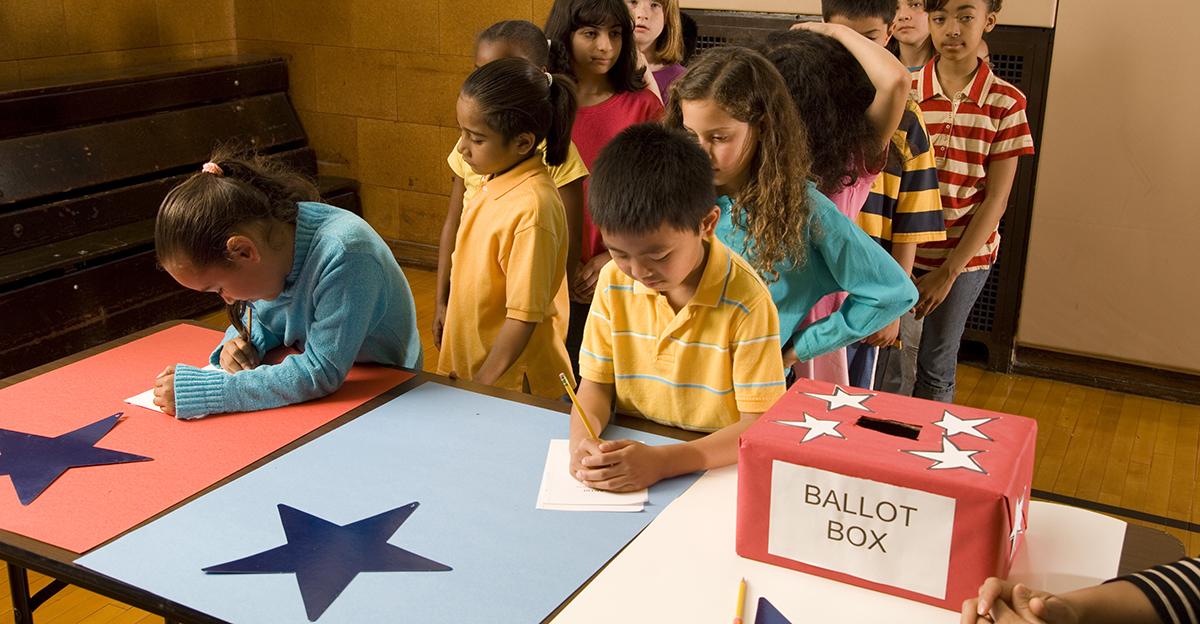
For an interactive experience, Scholastic’s Election Activity Kit is a great resource for encouraging kids to understand the election process and get involved. It includes an election timeline, ballots, voter registration forms, and easy-to-assemble ballot box to help raise student awareness and promote good citizenship!




This lesson plan is a gem for educators. It breaks down a complex political process in a way that’s both understandable and engaging for students. The activities are thoughtful and clearly designed to spark meaningful discussions about democracy and civic responsibility. It’s the kind of resource that makes social studies come alive in the classroom and helps students see the relevance of what they’re learning.