

Resilience, grit, perseverance, positivity — these are all ingredients that make up a growth mindset. As you help your students strengthen these skills, you’ll be teaching them how to overcome obstacles in school, in their relationships, and in every aspect of life. Follow these tips to learn how to develop a growth mindset in your students to foster social-emotional growth and academic success.

1. Create a supportive classroom environment
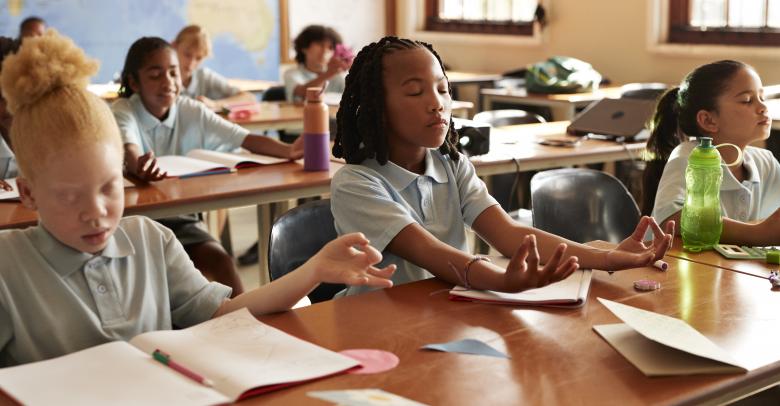
For students to be able to truly engage in any learning environment, they first need to feel safe and supported. Much of that support comes from the overall culture your administration sets for your school, but you can also build a welcoming environment within the microcosm of your classroom.
Along with social-emotional support, think about the physical environment your students are learning in every day and look for opportunities to offer autonomy. This could mean you allow flexible seating choices for work time, or it could mean you provide a calm-down corner where students can go to manage their emotions throughout the day.
When students feel supported and trusted in their classroom, they’ll feel more comfortable taking initiative, trying new things, and learning from their mistakes.

2. Practice goal-setting
Goal-setting doesn’t come naturally to everyone, especially young adults who are still developing their executive functioning skills. Use resources such as the Self-Esteem and Life Skills Plus book, which provides reproducible activities that offer practice in goal-setting, problem-solving, building self-esteem, and more, to strengthen those areas.
Having a growth mindset means believing that you are capable of continually learning and accomplishing new things. You can help students grow their confidence in this area by teaching them how to set goals throughout their daily lives.
Once students understand how to set actionable and achievable goals, establish timely check-ins to monitor their progress and celebrate their accomplishments. Visual trackers, even for older students, are valuable tools for helping students see how far they’ve come.

3. Celebrate progress over perfection
Students who lack a growth mindset are easily frustrated when they can’t do something right the first time. By recognizing hard work and small wins, you can build their confidence and instill the belief that they can achieve greater things.
Help students by breaking down large projects into smaller tasks and setting goals along the way. When they achieve each goal, walk them through the “story” of their achievement, which could look something like this: “When we started, you didn’t know a lot about geometry. Today you learned more about right angles and how to identify a hypotenuse. That was a lot of hard work. You’re on your way to understanding more about geometry. I bet you’re proud of the work you did today.”

4. Provide challenges instead of worksheets
Many times, students’ grades are based on getting things right or filling in all the answers. By providing open-ended challenges, you give students opportunities to think critically about their choices, especially those that don’t result in things working the way they are supposed to the first time.
Some of the best challenges involve STEM/STEAM concepts. As students work through the stages of design thinking, they’ll have opportunities to test ideas, fail, and then redesign and test again, continuously learning along the way.
To cultivate resilience through STEM challenges, you can focus on individual projects or look for tools that can serve your whole school, such as the TeacherGeek Makerspace Cart, which comes with 40 challenges and over 15,000 parts and pieces. While working through the activities, students will be using their problem-solving, communication, collaboration, critical thinking, and creativity skills.

5. Talk about failure in a positive light
Part of celebrating failure is being aware of the language you use when talking about it. By modeling positivity, you can change the conversation around success and failure. For example, when a student’s bridge collapses during an engineering challenge, the conversation might look like this:
“Wow, Malia, you put a lot of work into trying a new design. How do you think it worked? There are engineers whose job it is to figure out why some bridges collapse. If you were an engineer, what would you identify as the weak spots in this design? How do you think you could make the design different to avoid that? I can’t wait to watch you test your next design!”
If the conversations around failure remain positive and you show how much you value effort over getting the right answer, students will learn to embrace challenges and overcome obstacles.
Through your modeling, they’ll also learn how to positively critique their own work as well as the work of their peers and come to view critiques as a learning experience and not as a judgment or list of their faults.
Remember change is difficult and takes time
The work you’re doing with your students every day will make a difference, no matter how small. As you continue to nurture them, your students will learn to embrace challenges, work through obstacles, learn from critiques, and develop growth mindsets that will help them experience success throughout life.


I teach a lot of one on one preschool kids. I prefer ages 3-6