
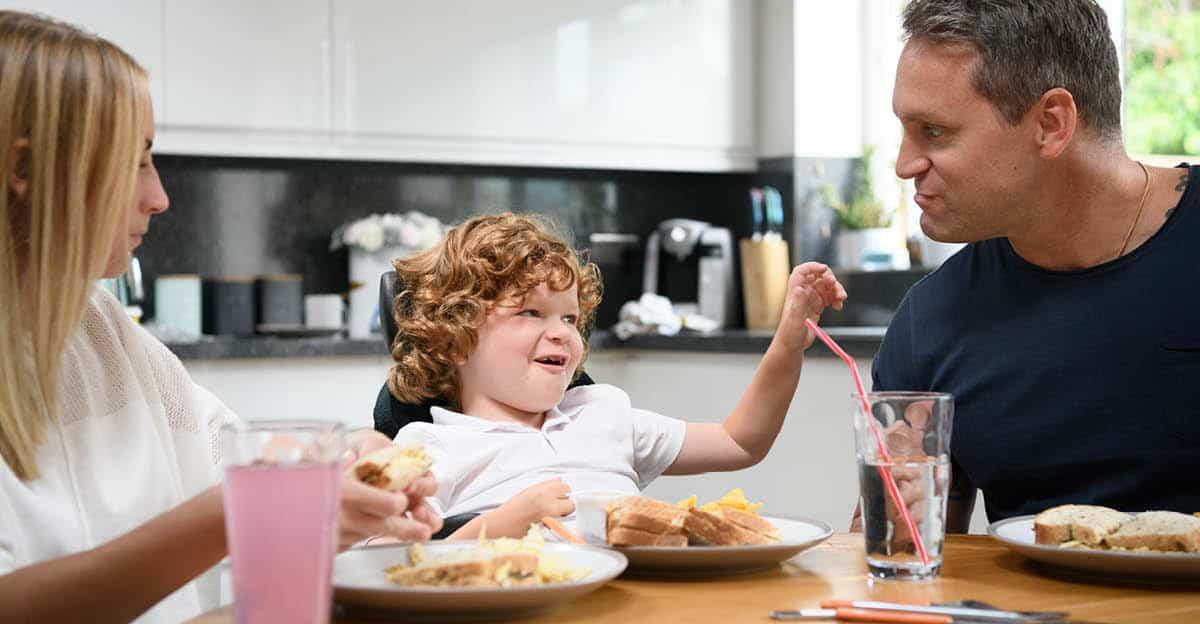
With the fall and winter festivals and holidays, there are usually food-related celebrations. There is an abundance of articles on kids with special needs who are picky eaters, but what about the child with a more severe/profound intellectual or motor disability? These 4 tips are ways to consider the needs of kids who experience more profound challenges at mealtimes, especially during the holiday season.
Table of contents
Meeting the Needs of Kids with Feeding Challenges
How do we include children with special needs in our holiday plans? Here are 4 ideas or solutions to keep in mind when creating mealtime plans:
Positioning:
Be sure the child is positioned properly to eat. Remember the 90-90-90 rule: Although there are variations for comfort and/or diagnostic implications, in general, this means feet/ankles, knees, and hips are all flexed or bent at 90° angles to ensure an upright posture. There is an old saying when encouraging infants to bottle or breastfeed: “flex the hips to open the lips!” Just as babies often calm and organize with hip flexion and pressure applied to the bottom of the feet, older children with special needs may need to continue this concept of hips flexed and feet well supported, touching a level surface or a foot plate.
Inclusion:
Include the child at the table whenever possible to allow for communication and socialization, even if expressive/receptive language skills are limited. Finger foods are also a great way to foster inclusion with other children and/or family members. If the child is being fed, allow for food choices when possible, using picture cues and/or a simple communication device.
Specialized Tools:
Try a specially designed fork for children with tremors and/or limited wrist mobility. Practice with sticky food first, such as mashed potatoes or oatmeal.
You can also take a regular stainless steel teaspoon and (with a little muscle!) bend the arm of the spoon to angle inward (left for right-handed and right if the child is left-handed). This will help reduce the need for more refined wrist movement (supination) and make self-feeding a bit easier.
Additional tools like the FabLife Scoop Plate and a Dycem nonskid mat may help provide stability and foster more independence with self-feeding.
If cup or straw drinking is an issue due to strength or coordination, try a Weighted Cup, which gives multiple options for grip and sip.
Nutrition:
Be mindful of nutritional needs for children who are slow/limited eaters. See the BHN tip sheet from the Academy of Nutrition and Dietetics for more information on key issues like nutritional intake, progressing from puree to solids, and limiting external distractions (toys, smart devices, etc.) during mealtimes for optimal success.
Be sure to consult with your child’s Occupational or Speech Language Pathologist for best practice and individualized recommendations. With a few extra accommodations, all children can be included in holiday food celebrations.
More Special Needs Holiday Tips and Inspiration
Whether there’s a student with special needs in your life or on your gift shopping list for the holidays, be sure to stop by the Special Needs category to find great stuff. There are gift ideas, activity inspiration, and more.

Cecilia Cruse, MS, OTR/L has a BS degree in Occupational Therapy from the University of Florida, and her Master’s degree in Education from Georgia State University. She is SIPT certified and has over 25 years of experience in pediatrics with school-based services, acute care, and outpatient pediatric settings.




Leave a Reply